Origin vs. Shipping Point: How Canadian Customs Decides If the Surtax Applies (Fall 2026)
Published: octubre 7, 2026
Where did your goods ship from? It’s a fair question, but it’s not the one Canadian customs is asking.
Canada’s new surtax, in effect since September 8, 2026, doesn’t follow the route your goods take. It follows their country of origin, as determined under Canadian regulations. For Calgary importers working with cross-border suppliers, that one distinction decides whether the surtax applies at all.
As of September 8, 2026, here’s the rule
The surtax is charged at 15%, 25% or 50% of the value for duty, and only on specific tariff items listed by Finance Canada. It applies only to goods eligible to be marked as U.S. goods under Canada’s CUSMA marking regulations.
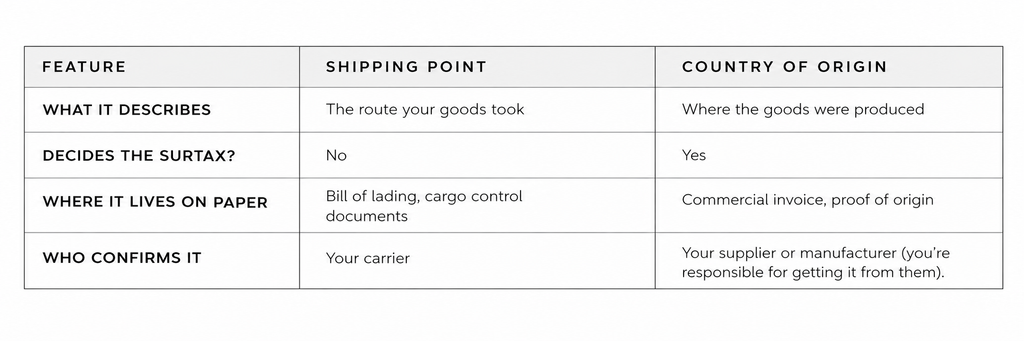
Not “shipped from.” Not “supplier located in.” Origin.
How Canadian customs works out origin
This isn’t a judgment call made at the border. The marking rules are technical, and they’re applied the same way every time.
The part that catches importers off guard is what happens with goods that pass through someone else’s hands. When goods only undergo what the regulations call minor processing, origin is determined by the materials that give the product its essential character. A company sitting between you and the manufacturer doesn’t automatically change where something is “from.”
Shipping point vs. country of origin
Three situations to watch for
1. Your supplier is cross-border, but the product isn’t made there.
A distributor a few hours south may carry goods manufactured somewhere else entirely. If those goods only underwent minor processing along the way, origin generally stays with where they were made. That can mean the surtax doesn’t apply, as long as your documentation shows it.
2. The product is surtax-origin, but it shipped from somewhere else.
This works in the other direction too. The surtax applies even when goods are exported to Canada from a third country. Routing doesn’t reset origin.
3. One shipment, several origins.
The surtax list is set at the tariff-item level, and origin belongs to each product, not to the invoice. A single shipment can carry some lines that are surtaxed and some that aren’t.
What actually proves origin
For commercial goods, proof of origin can be a commercial invoice or other documentation that contains the required minimum data elements. If your supplier’s invoices are vague about where products were made, this is the season to ask for better ones.
A properly completed Factura de aduanas de Canadá (en inglés) is a good place to start. Our guide to country of origin certificates covers what solid origin records look like.
This matters beyond the day your goods clear. CBSA can review origin, tariff classification, and valuation after release. Clear records are what keep a routine verification routine.
Two more things worth knowing
If you want certainty before you order, you can request a binding advance ruling on origin, tariff classification, or marking for goods imported from CUSMA countries. Most importers won’t need one, but it’s worth knowing the option exists.
If something was declared incorrectly, it can be adjusted through the CARM Client Portal. GST is calculated on a value that includes the surtax, so a surtax error carries through to your GST and your Statement of Account.
Where your Calgary customs broker fits
Origin rules apply the same way whether your goods arrive by truck at a land border or by air. That includes the air freight options we covered in Why More Businesses Are Turning to Air Freight This Fall.
Ramsay’s licensed customs brokers in Calgary and Vancouver manage the details that decide how this plays out for your business:
- CBSA clearance
- tariff classification
- duties and GST calculations
- PARS releases
- CARM compliance
That work comes with compliance guidance aimed at keeping your import operations audit-ready. And because Ramsay coordinates freight and customs brokerage together, documentation issues are easier to catch before they turn into clearance delays.
If your supply chain crosses the border regularly, see how our border broker services support cross-border shipments. If CARM still feels like a moving target, read what a CARM-focused broker should be doing for you.
For the official rules behind customs clearance in Canada this fall, see CBSA’s Customs Notice 26-23 and Finance Canada’s list of products subject to the surtax.
Ship it, Declare it, Store it: we’ll make sure the paperwork behind all three holds up.
👉 Contact Ramsay today to review your customs documentation and reduce the risk of border delays.
✉️ im*****@*************cs.com